

Dressage Lessons That Build Better Riders
Private dressage lessons build confident, balanced riders through focused coaching, clear goals, and thoughtful horsemanship at every stage of growth.
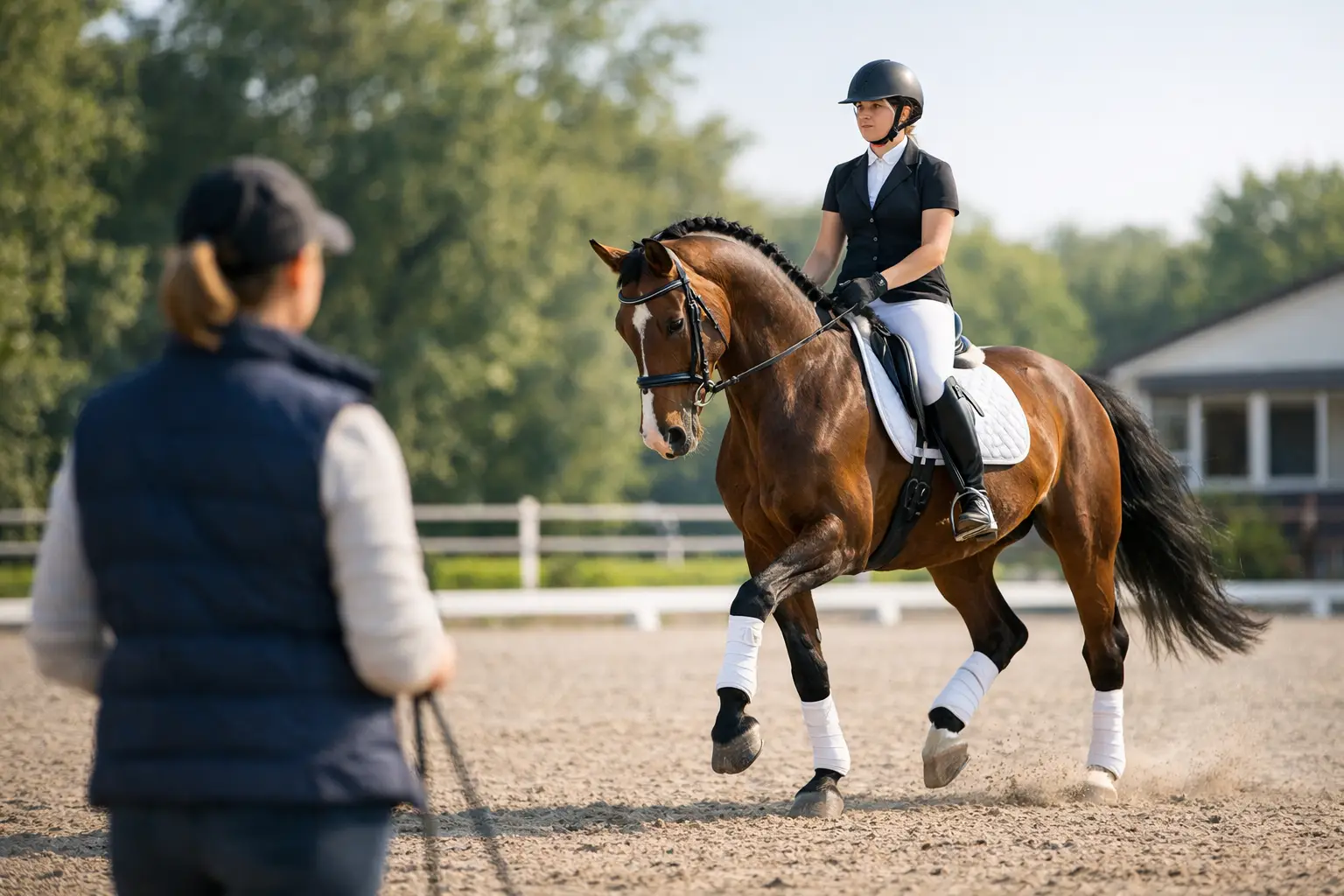
A horse that speeds up through every downward transition, a rider who cannot keep their hands still, or a circle that seems to change shape on every stride - these are not failures. They are useful information. Quality dressage lessons teach riders how to read those moments, make a thoughtful adjustment, and give the horse clearer support rather than simply asking for more effort.
Dressage is sometimes mistaken for a discipline reserved for formal competition rings and advanced riders. In reality, its foundation is simple and valuable for nearly every English rider: developing a horse that is balanced, attentive, and willing, paired with a rider who communicates with quiet confidence. Whether a child is learning the basics of steering or an adult amateur is refining lateral work, dressage provides a framework for progress that carries into jumping, trail riding, and everyday horse care.
What Dressage Lessons Really Teach
At its heart, dressage is the art of improving the horse through systematic, correct training. The goal is not to make a horse look manufactured or overly restrained. A well-schooled horse should move forward with relaxation, rhythm, and responsiveness, while remaining comfortable in its body and confident in its work.
For the rider, that starts with position. A balanced seat, steady leg, and following hand give a horse consistent information. Riders learn that small changes in their own posture can affect a turn, transition, or halt far more than pulling on the reins ever will. This is why dressage is such a powerful foundation for young riders and experienced equestrians alike.
A thoughtful lesson also builds the rider's eye. Instead of asking only, “Did we complete the pattern?” a rider begins to notice whether the horse stayed straight, whether the rhythm changed in the corner, and whether a transition happened from the seat and leg rather than the hand. Those observations lead to better decisions in the saddle.
Why Private Instruction Makes a Difference
Dressage is detailed work. Two riders may be practicing the same exercise, yet need entirely different coaching. One may need help keeping weight even through both stirrups. Another may need to soften a busy rein or establish a more active walk before attempting a transition. In a private setting, the instructor can address the reason behind the issue rather than offering a broad correction to the group.
That individual attention matters just as much for the horse. Some horses benefit from shorter, frequent sessions that emphasize relaxation. Others are ready to develop more engagement, adjustability, and accuracy. The right program considers the horse's fitness, experience, temperament, and current training, not just the rider's next goal.
For families, private coaching also creates a clearer picture of progress. Parents can see what their child is learning, why a particular skill matters, and what responsible habits belong at the barn as well as in the saddle. Riders gain confidence because expectations are appropriate for their stage of development, not set by the pace of the most experienced person in an arena.
The Building Blocks of Effective Dressage Lessons
Early dressage work is intentionally straightforward. Riders first develop an independent position and a reliable connection with the horse. They learn to guide the horse through accurate figures, maintain an even tempo, and ride transitions without losing balance.
From there, lessons may introduce more refined exercises. Serpentines, circles of different sizes, changes of bend, and transitions within the gait help improve suppleness and response. Later, lateral movements such as leg-yield can teach a horse to move away from the rider's leg while staying forward and straight.
Each exercise has a purpose, but the purpose should never be hidden behind complicated terminology. A good instructor explains what the rider is trying to feel and why it benefits the horse. For example, a well-ridden circle can reveal whether a horse is falling inward, drifting through the outside shoulder, or losing impulsion. Once the rider understands the pattern, the correction becomes more meaningful.
Progress is rarely a straight line. A rider may have a lovely trot one day and struggle to recreate it the next. Horses have physical and mental variables too, including energy level, soreness, turnout changes, and distractions in the environment. Productive instruction recognizes those variables while maintaining standards for safety, kindness, and correct basics.
The Horse Comes First
Dressage asks horses to become stronger, more coordinated, and more responsive over time. That work must be supported by appropriate conditioning, sound footing, well-fitted tack, rest, and attentive daily care. No riding exercise can compensate for a horse that is uncomfortable or physically unprepared for the request.
This is one reason horsemanship belongs alongside riding instruction. Riders should learn to notice changes in behavior, understand basic grooming and tack checks, and respect the value of a proper warm-up and cool-down. Those habits create more capable horse people, not just riders who can complete a test.
Dressage for Children, Adults, and Competitive Riders
For children, dressage offers structure without requiring a child to be naturally fearless or highly athletic on day one. The focus on body awareness, clear routines, and patient repetition can be especially helpful for building confidence. As riders mature, they also learn responsibility, self-discipline, and how their choices affect the horse beneath them.
Adult riders often appreciate dressage because it rewards thoughtful improvement. A successful lesson may mean sitting the trot more quietly, achieving a square halt, or feeling a horse soften into contact for a few correct strides. Those gains are real, even when they are not dramatic from the rail.
For riders who compete, dressage provides measurable goals and useful feedback. Tests can highlight strengths and expose areas that need more schooling, such as accuracy, rhythm, or consistent contact. However, competition should support the training process rather than rush it. A horse-and-rider pair is ready to show when the work at home is calm, correct, and repeatable.
Dressage also benefits jumpers. A horse that responds promptly to half-halts, stays balanced through turns, and moves forward from the leg is easier to guide to a fence. The trade-off is that flatwork requires patience. Riders hoping for instant results may find repetition challenging, but the payoff is a more adjustable, confident partner over time.
How to Get More From Each Lesson
Come to each ride with one simple intention. It might be maintaining a marching walk, looking through every turn, or preparing transitions earlier. A focused goal helps a rider avoid trying to correct everything at once.
It also helps to ask questions. If an exercise feels difficult, riders should understand whether the challenge is their position, timing, the horse's balance, or a combination of all three. Taking a few moments after the lesson to recall one success and one skill to practice can make the next ride more productive.
Between lessons, resist the urge to practice a new exercise until it becomes forced or frustrating. Correct basics done consistently are more valuable than advanced movements attempted before the horse and rider are ready. In a personalized program, the trainer can help determine when to repeat, simplify, or move forward.
At Eden Hills Equine, individualized instruction gives riders room to build those fundamentals with focused coaching and careful attention to both horse and rider. The aim is not simply to produce a better-looking ride. It is to develop clear communication, capable horsemanship, and confidence that lasts beyond any single lesson.
The best dressage lesson often ends with a small change that feels surprisingly clear: a quieter transition, a straighter line, a horse that takes one more relaxed breath. Notice it, reward it, and let that honest progress shape the next ride.