

What to Expect From English Riding Lessons
English riding lessons build confidence, safety, and true horsemanship. Learn what beginners, parents, and advancing riders should expect.
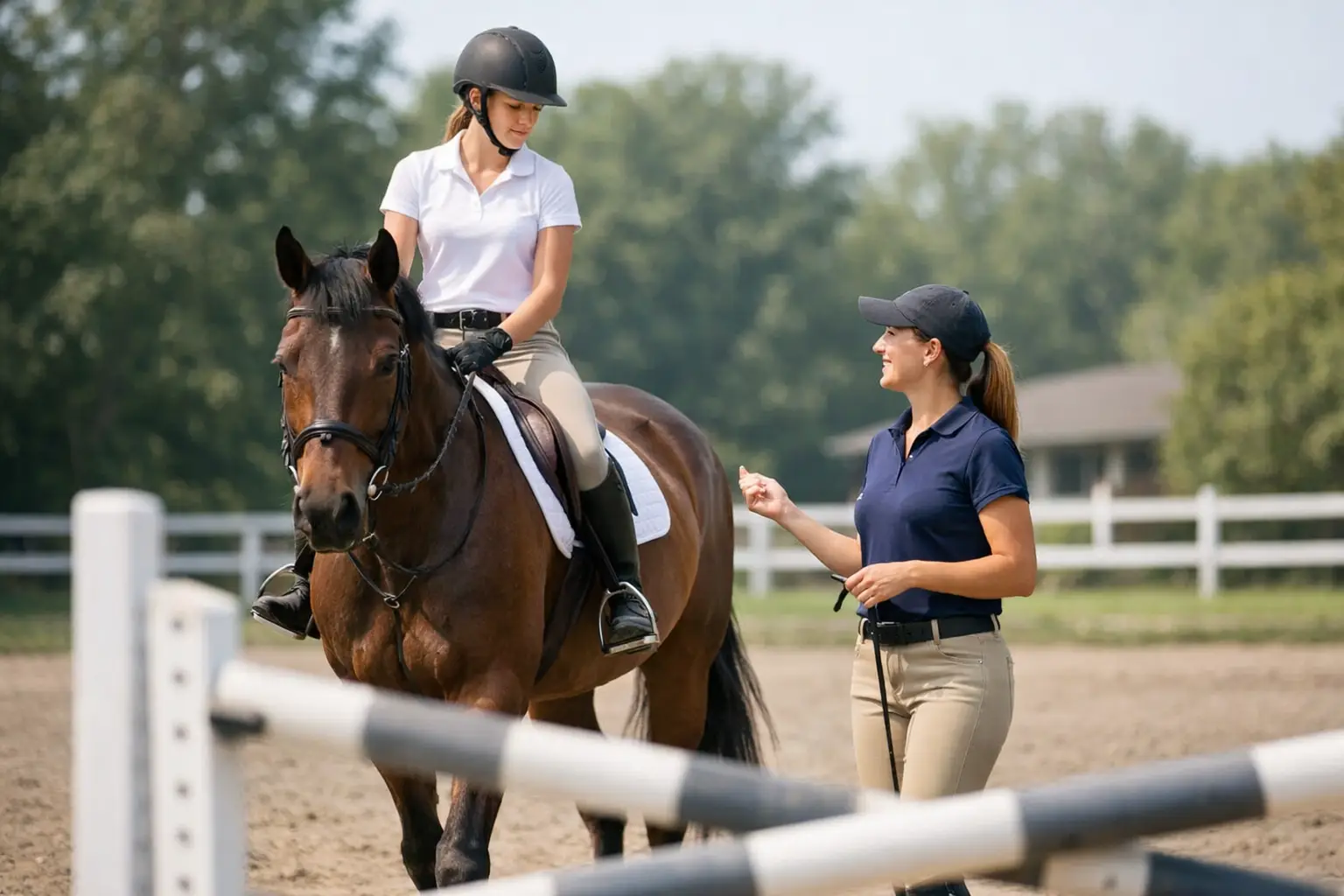
The first real sign of a strong riding program is not how quickly someone learns to post the trot. It is how carefully those first skills are taught. English riding lessons should build confidence and discipline at the same time, giving riders a clear path forward while keeping horse welfare and safety at the center of every ride.
For families, that often means looking beyond whether a child simply enjoys horses. A good lesson should teach responsibility, patience, body awareness, and respect for the animal underneath the saddle. For teen and adult riders, it usually means something just as valuable - individualized coaching that turns effort into measurable progress instead of leaving riders to guess what comes next.
What English riding lessons actually teach
English riding is often associated with hunt seat, jumping, and dressage, but the foundation is broader than many people expect. Riders learn how to sit in balance, keep an independent leg and hand, follow the motion of the horse, and communicate with precision rather than force. Those basics matter whether a rider stays at the walk and trot for a while or eventually moves into more advanced flatwork and fences.
The best programs also teach horsemanship alongside riding skills. That includes grooming, tacking up correctly, understanding basic horse behavior, arena etiquette, and safe handling on the ground. Especially for younger riders, that education is not extra. It is part of becoming capable and trustworthy around horses.
This is where lesson quality can vary. Some riders need repetition and confidence-building. Others are ready for technical detail and stronger expectations. A thoughtful instructor adjusts the lesson to the person in front of them rather than teaching every rider the exact same way.
Why private English riding lessons matter
Private instruction gives riders something group settings often cannot - full attention. In a one-on-one lesson, every correction is immediate, every exercise has a purpose, and the pace can match the rider instead of the group.
That matters for beginners because early habits form quickly. A rider who is tense in the shoulders, unsteady in the lower leg, or unclear with the reins benefits from direct feedback before those patterns become harder to fix. It also matters for more experienced riders, who often need specific coaching on position, timing, transitions, course work, or dressage accuracy.
Private English riding lessons are also valuable when a horse-and-rider pair is developing together. If a rider is working with a leased horse or their own horse, the lesson can focus not only on the rider's position but also on how that particular horse goes, where the communication breaks down, and what exercises will help both improve.
There is a trade-off, of course. Group lessons can be social and, in some cases, lower in cost. But when the goal is safety, steady progress, and a program tailored to the individual, private instruction usually delivers more value per ride.
What beginners should expect in early lessons
A first lesson should feel structured, calm, and welcoming. Riders may begin by learning how to approach the horse, groom, lead safely, and understand basic tack. Once mounted, the focus is usually on balance and control at the walk before moving on to steering, stopping, and simple position work.
For children, especially, progress should not be rushed. Confidence grows when riders feel secure and understand what they are being asked to do. Some students are eager and athletic right away. Others need several lessons just to relax in the saddle and find rhythm. Both are normal.
Parents often ask how quickly a child will canter or jump. The honest answer is that it depends. Age, coordination, confidence, consistency, and the rider's ability to absorb instruction all play a role. A quality program does not skip the basics just to create a faster-looking result.
For adult beginners, there can be a different challenge: self-consciousness. Many adults worry they are starting too late or feel frustrated when riding does not come naturally in the first few lessons. In reality, adults often do very well because they listen carefully, think critically, and appreciate the process. The key is patient instruction that builds skill in logical steps.
What advancing riders should look for
Once riders are comfortable with the basics, lessons should become more specific. A rider interested in jumping may begin focusing on pace, straightness, pole work, two-point strength, and seeing a track to a fence. A rider drawn to dressage may work on suppleness, transitions, contact, geometry, and the horse's responsiveness to subtle aids.
At this level, generic instruction starts to hold riders back. Serious progress comes from coaching that identifies the smallest details - where a rider collapses through a hip, loses connection in a downward transition, or supports too much with the hand instead of the leg. These are not dramatic mistakes, but they make a major difference over time.
Advancing riders also benefit from a program that looks at the whole picture. Fitness, consistency, horse suitability, and goal setting all matter. A rider preparing for a show season needs something different from a rider coming back after time away or someone refining skills for personal satisfaction.
Safety should shape every lesson
Safety in a riding program is not just about helmets, though those are essential. It is reflected in the horses used for lessons, the condition of the footing, the design of the facility, the way riders are supervised, and the standards expected on the ground as well as in the saddle.
A well-run program pairs riders thoughtfully with horses that suit their current ability. It does not ask beginners to manage situations beyond their experience. It teaches riders how to read ears, movement, and energy level so they can respond appropriately instead of becoming intimidated.
Good instruction also keeps riders progressing within reason. Challenge is necessary. Overfacing is not. The right lesson stretches ability without creating fear or confusion. For many parents, that balance is one of the clearest signs that they have found a program they can trust.
The role of horsemanship in long-term success
Riders who only learn what to do once they are in the saddle often hit a ceiling. Horsemanship fills in the rest. It teaches why a horse reacts the way it does, how daily care affects performance, and what good partnership looks like beyond the lesson itself.
That foundation is especially helpful for families considering a lease or eventual horse ownership. Learning to ride is one part of the equation. Learning to care for, manage, and advocate for a horse is another. When students understand both, they make better decisions and become more capable horse people.
This approach also tends to create more grounded young riders. They learn that horses are not sports equipment. They are athletes and partners that require consistency, respect, and thoughtful care.
Choosing the right English riding lessons for your goals
Not every rider wants the same outcome, and a strong program should recognize that. Some families want a child to develop confidence, discipline, and riding fundamentals in a structured environment. Some teens are ready for more technical work and competitive goals. Some adults want to return to riding with patient, professional guidance. Some owners need a place where training, instruction, and horse care support each other.
The right fit usually comes down to a few questions. Is the instruction personalized? Are expectations clear? Does the program teach horsemanship, not just riding? Is the environment calm, clean, and professionally managed? Do riders receive enough individual attention to make real progress?
At a boutique program such as Eden Hills Equine, those details are part of the experience, not extras. One-on-one coaching, a safety-minded setup, and careful attention to both horse and rider create the kind of steady development many families and dedicated riders are actually looking for.
English riding lessons should do more than fill an hour in the week. They should help riders become capable, confident, and thoughtful in the saddle and around the barn. When that happens, progress feels earned, trust grows naturally, and the relationship with the horse becomes the reason riders stay with the sport for years.